Carpet Installation
.png)
CORRECT MEASURING
Proceed carefully and measure several times to avoid problems when you discover that a few centimetres are missing.
Here are a few tips and pieces of advice from us:
• always measure at the longest and widest part of the room
• measure the length and width of the room at several points due to
uneven walls
• do not forget alcoves and door frames – add these areas as well
(the flooring is laid right up to the door leaf)
• add a 5–10 cm allowance to the room length
• keep in mind that the tolerance in length and width for wall-to-wall carpets is ±1 % (according to STN EN ISO 14159)
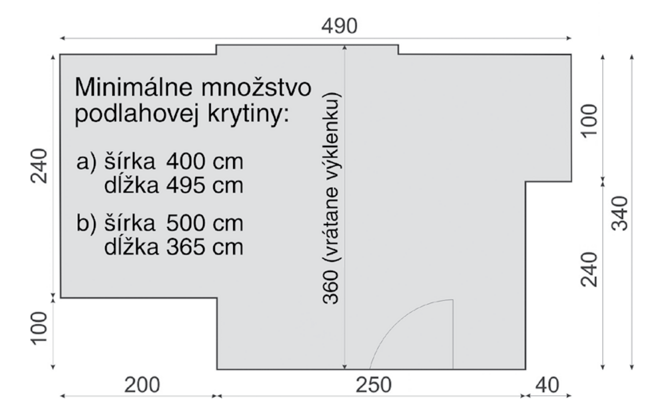
Draw the length and width of the room into a basic floor plan, marking window alcoves, radiators and doors. Also remember wall projections, e.g. around a fireplace. It is better to purchase a larger wall-to-wall carpet than to patch it with pieces. Offcuts can be used, for example, to make a skirting or, from larger pieces, entrance mats or yarn-edged
rugs.
Where possible, avoid seam joints.
.jpg)
SUBFLOOR PREPARATION BEFORE INSTALLATION
The subfloor must be flat, dry, firm, clean (swept and vacuumed) and free of cracks. A new cement or anhydrite screed must be sanded and cleared of loose particles, then levelled with a suitable self-levelling compound. The same applies to any uneven surface.
Expansion joints must be preserved. Before applying the levelling compound and before carpet installation, the subfloor must be treated with a suitable primer.
The permissible range of local flatness deviations of the wearing surface is defined according to STN 74 4505, and in rooms with permanent pedestrian traffic (flats, offices, etc.) it is ±2 mm.
Local flatness deviations are measured using a 2 m reference straightedge supported at both ends by spacers, together with a measuring wedge.
The recommended room temperature during installation is min. 18 °C and relative humidity up to 75 %. The maximum permitted subfloor moisture content measured by the CM method according to STN 74 4505 is 3.2 % for cement screed (concrete) and 0.5 % for calcium sulphate-based screed (anhydrite).
If an underfloor heating system forms part of the floor construction, the maximum permitted moisture requirement for cement screed must be reduced by 0.5 % and for calcium sulphate-based screed by 0.2 %.
Pay special attention to moisture checks before installation in basement and cellar spaces, in older recreational buildings that may not be sufficiently insulated against rising damp or condensation caused by temperature fluctuations resulting from inadequate ventilation and heating due to weekend-only use.
.jpg)
Carpet preparation – acclimatisation
A wall-to-wall carpet must be left unrolled in the room for 24 hours before installation so that it can acclimatise (adjust to the humidity, temperature and environment). After unrolling the carpet, inspect it visually, and if any defect is visible, it must be reported as a claim before you begin trimming it to size.
If the carpet width significantly exceeds the room width, it is advisable to trim it, but never to the exact dimension.
The recommended allowance is approx. 5–10 cm on each side.
.png)
CARPET INSTALLATION
To achieve the required properties, the carpet must be fixed to a flat subfloor. If laid loose, faster wear of the floor covering may occur (e.g. due to buckling, bulging or shrinkage caused by climatic conditions), which cannot be considered a product defect.
Installation with double-sided adhesive tape
Installation with double-sided adhesive tape is the simplest method, but it can only be used in smaller, low-traffic areas (up to approx. 20 m²). The double-sided tape is applied along the perimeter of the room (approx. 3 cm from the wall) and in the centre of the room in a grid pattern with individual strips approx. 1 m apart.
Full-surface glue-down installation
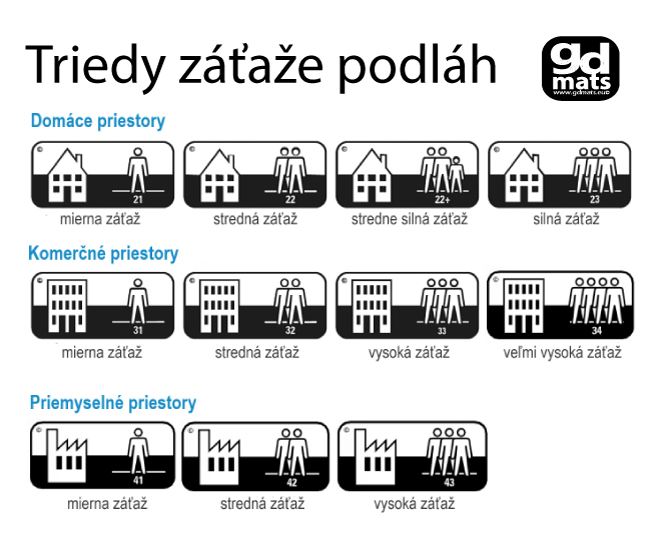
The manufacturers' recommended method for carpet installation is full-surface bonding with a suitable dispersion or pressure-sensitive adhesive. This prevents the formation of bubbles and buckling, and ensures that the manufacturer's declared product properties are achieved (e.g. wear class – see the symbols below), as well as dimensional stability.
The choice of adhesive suitable for the carpet backing and the expected load is important. Pressure-sensitive adhesives can be used
in less heavily loaded areas where the carpet is installed without seams. The advantage of pressure-sensitive adhesive is easier carpet replacement.
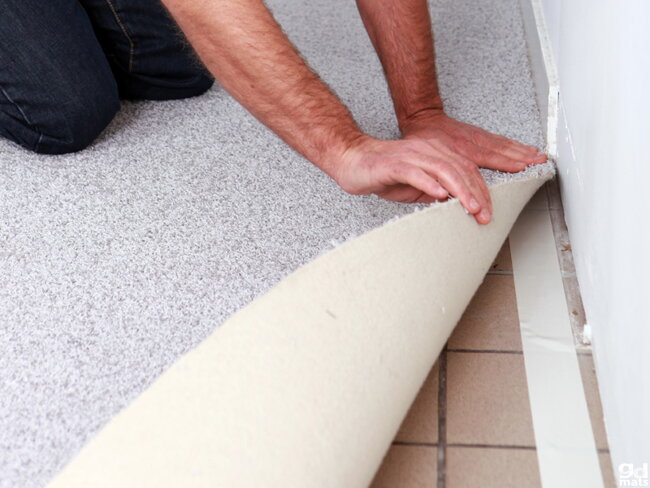
After acclimatisation and cutting the carpet with a 5–10 cm allowance (see above), use a sharp knife to cut the carpet at alcoves, doors, pipes, radiators, etc.
Then fold the covering into the centre of the room and, using a suitable notched trowel (notch size according to the type of adhesive and covering), apply the adhesive to the subfloor. Allow the adhesive to flash off according to the instructions.
Thoroughly press out any air bubbles working from the centre towards the edges. Fold the second half of the carpet back to the centre of the room and continue in the same way as when bonding the first half. After full bonding, trim the covering precisely along the walls and alcoves.
.jpg)
Installation on a carpet underlay
If greater comfort, thermal or acoustic insulation is required, it is advisable to use a special underlay for carpet coverings (available in our stores). Choose the type of underlay according to the intended use and load.
Two installation methods are possible. The first is the so-called double bonding, where the underlay is glued to the prepared subfloor with a pressure-sensitive adhesive and the carpet is then bonded to the underlay with a dispersion adhesive.
The second option is the so-called stretching method, which should be entrusted to a specialist flooring company. Under no circumstances should the carpet be laid loosely on the underlay. Always bond the seams with a suitable contact adhesive to prevent a gap forming at the joint.
.jpg)
Joining carpets
When joining carpets, ensure that all pieces are laid in the same direction and come from the same production batch (lot number).
Width cannot be extended with length, nor can pieces from different widths be combined. Failure to follow these principles results in visible colour shade differences between the joined pieces. When joining patterned carpets – whether the pattern is textural or colour-based – it must be taken into account that inaccuracies in symmetry are governed by the relevant standards and patterns do not necessarily align with absolute precision.